The Mission
Policing in the 1980s and the early 1990s had lost its way. There was an underlying assumption that crime rates were based on the social demographics of a community; things like the amount of poverty, education, drug use, or family dysfunction. Police leaders believed they could make a difference when a serious offence took place and they worked hard to put the bad guy in jail, but for overall safety, police were there to just "hold the line". When I was in charge of a district at VPD, my commercial Break and Enter rate doubled in one quarter. A detective phoned me and asked if I had noticed the problem (I sadly had not). No boss that I reported up to noticed the crime wave.
I watched closely as NYPD Commissioner William Bratton announced that the NYPD could make a community safe. [1] In his short two-year time in that office (1994 to 1996), New York's crime rate dropped by 75%. They had been provided an influx of new members and put in place a number of innovative strategies. Many of these strategies were developed by Deputy Commissioner Jack Maple.[2] Bratton said words to this effect: It turns out that crime is caused by people, and people can be stopped.
There is reporting that there were some issues with how this was done. Putting lots of pressure on police to reduce crime without being very careful that members colour inside the lines can lead to problems. There were also lessons about what worked and what did not. The principle though was clear, police could reduce crime and make a community safe. To do that, police leaders needed to keep their eye on the ball.
My thesis is this. The mission of first responders is to make or keep the people in their community safe. Mission statements amongst first responder agencies often include a lot of different ideas that are very lovely, but are not actually about the mission.
In 2008, the mission of the Abbotsford Police Department became (and still is): To Make Abbotsford the safest City in BC. We debated making it: To Make Abbotsford Safe. The four extra words make the mission measurable.
I just read the strategic plan of a major Canadian police service. It did not contain a mission statement nor did it contain any commitment to making the community safe. It had all the important values and commitment to community you could ever want. That is all essential. However, and respectfully, what the community really needs to be is safe. Keep your eye on the ball.
It may seem trite to go back to this, but the first truly civilian police service in Europe was the London Metropolitan Police Force, established by Sir Robert Peel in 1829. He became known as the "Father of Modern Policing." His people established a list of policing principles that remain as central to the mission of policing today as they were two centuries ago.
Completing the mission → Means A Focus On Prevention
For Police, Peel Got It Right
Sir Robert Peel and his team put together the first real civilian police service – London, 1829. He and his team came up with 9 principles:
All of these principles remain fundamental. It amazes me the first truly civilian police service in the western world got this much right.
Look again at the first five words, To prevent crime and disorder, and to the last principle, that the test of police efficiency is the absence of crime and disorder.
To be sure, the principles include the need to hold the public trust, to understand that police are part of the community and that integrity in the performance of duties is essential. Police cannot make a community safe without effective partnerships with their community and the trust of the public.
But the mission is to make the community safe. That is best done by preventing crime. Investigating crime and bringing people to justice is essential, but wherever possible, it is far better to have prevented the crime from ever taking place.
I once read a person's critique after my attempt to teach leadership to a group of investigators. I had confessed to them that I was not as accomplished at investigating as they were. The person wrote that I had no credibility because being an investigator is all that police do. I remain discouraged that I failed to get through to that person about our real role in society.
To prevent crime and disorder, as an alternative to their repression by military force and severity of legal punishment.
To recognize always that the power of the police to fulfill their functions and duties is dependent on public approval of their existence, actions and behavior, and on their ability to secure and maintain public respect.
To recognize always that to secure and maintain the respect and approval of the public means also the securing of the willing cooperation of the public in the task of securing observance of laws.
To recognize always that the extent to which the cooperation of the public can be secured diminishes proportionately the necessity of the use of physical force and compulsion for achieving police objectives.
To seek and preserve public favor, not by pandering to public opinion, but by constantly demonstrating absolute impartial service to law, in complete independence of policy, and without regard to the justice or injustice of the substance of individual laws, by ready offering of individual service and friendship to all members of the public without regard to their wealth or social standing, by ready exercise of courtesy and friendly good humor, and by ready offering of individual sacrifice in protecting and preserving life.
To use physical force only when the exercise of persuasion, advice and warning is found to be insufficient to obtain public cooperation to an extent necessary to secure observance of law or to restore order, and to use only the minimum degree of physical force which is necessary on any particular occasion for achieving a police objective.
To maintain at all times a relationship with the public that gives reality to the historic tradition that the police are the public and that the public are the police, the police being only members of the public who are paid to give full-time attention to duties which are incumbent on every citizen in the interests of community welfare and existence.
To recognize always the need for strict adherence to police-executive functions, and to refrain from even seeming to usurp the powers of the judiciary of avenging individuals or the State, and of authoritatively judging guilt and punishing the guilty.
To recognize always that the test of police efficiency is the absence of crime and disorder, and not the visible evidence of police action in dealing with them.
Leadership Defined
Influencing your team towards accomplishing the mission.
Unpacking this definition:
Influencing versus directing: A manager often directs people to do certain tasks. All fine when needed, but that is not leadership. Leadership is about setting an example, convincing and motivating people to work together, and creating a desire to get the job done together.
Accomplishing a mission: A leader has in mind what the team is to do to succeed. It may need to be flexible or have to be adjusted, but the leader defines it as sharply as possible and convincingly helps makes it the team's goal.
Hold the Line: All this has to be done while still "colouring inside the lines". The law, ethics and everyone's integrity must be maintained, despite the temptation that may arise to cut a corner to get the job done. The leader's other job is to hold that line.
Leadership is Not About Rank
In hierarchal organizations with uniforms and rank insignia, there is a tendency to equate rank with leadership. You are the boss so you are the leader. The reality is that great leaders show up in the front ranks and will have significant impact on the culture and performance of a team. It is also true that someone can attain rank without ever leading. They might manage their workload and show up at all the right meetings, but fail to actually move the team towards the mission or keep team members well.
Leadership is about positively influencing a team towards a goal. If you show up and influence your team to stay positive and on track, if you help find ways for the team to do its work better, if you work to keep your work environment healthy and not toxic, you are a leader. Obtaining rank might change how you lead and the amount of influence you have, but if you want to lead, step out now.
First step in being a leader is to know yourself. What do you bring to your workplace? What are your strengths? What do you need to work on to be a better leader? An honest assessment is what is needed; not being overly critical, and not glossing over the stuff that needs work.
You will need to ask others for feedback about how you are coming across and what they observe when they watch you at work.
Step 1 – Be Self Aware
-
I am too often a poor listener, wanting to jump ahead to conclusions or start talking too soon. Also, sometimes I have used humour when I should have been more careful about how I was coming across. Good colleagues have helpfully pointed these things out to me so I could work on them.
One option is to ask for a formal 360 evaluation. This is a process where the people that report to you, your peers and your bosses provide feedback that is then packaged up and provided to you. If you do this, pay a lot of attention to what your reports have to say. They are the ones who know the most about your leadership.
If you have integrity, the courage to do the right thing, and care about the people you work with and serve, you have the essential character to lead. The rest is stuff to work on and get better at (knowing all of us are a work in progress).

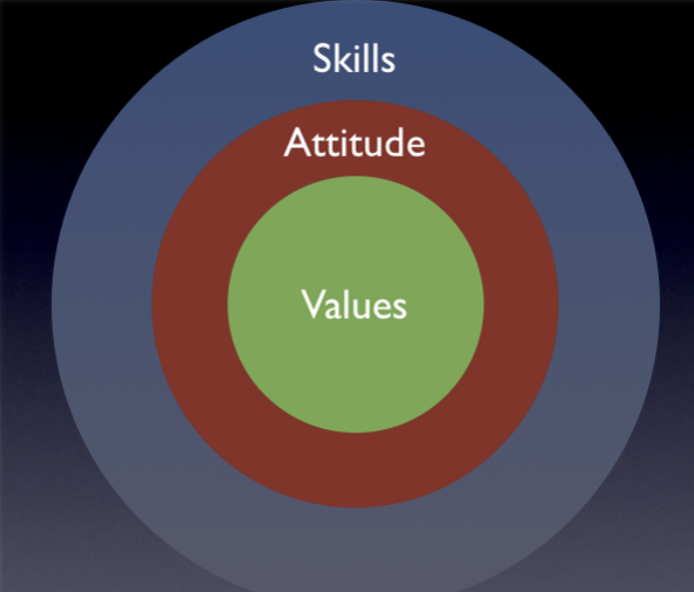
This is a critical skill for a leader. The model I use as a guide I got from my colleague John McKay, a use of force expert and trainer extraordinaire.
The outer circle is about a person's skills, knowledge and abilities. Is a person physically fit enough to be a firefighter? Do they have the intellect and dexterity to be a paramedic? Do they have the skills to drive a vehicle code 3?
The next circle is about someone’s attitude towards others; their people skills, and their ability to communicate and connect with others. All first responders have to work well with colleagues. Can the person get along so the team can mesh and function well? Do they have empathy for victims of violence or accidents?
At the center is a person's character. Integrity and courage are essential to someone in the first responder business.
Step 2 – Evaluating People
-
When I was Chief of the Abbotsford Police, I asked every recruit we hired to come and meet me before their swearing in ceremony.
I said, “In a few minutes, we will go into the next room where I will tell your family and friends how amazing you are, Your parents will take pictures and I will hand you a shiny new badge. But before that, let me explain how you will be evaluated and ultimately what will get you fired from this job.”
On a scrap of paper I would draw the three circles and say this: "The outer circle are the skills you have to learn to be a police officer, drive a car, shoot a gun, interview a witness, and write a report. If one of those skills proves hard for you, we will do our best to coach and help you so you can do the job. Eventually, if you can't figure out how to shut a gun, we will let you go, but that almost never happens."
"The next circle is your ability to work with people. This is a people job and we need you to do well on a team, to connect with the public, to show empathy to a victim and to treat the public with respect. If we see an issue, we will likely point that out for you and see if you can correct it, but we have hired you believing that you have what this takes."
"The final circle is about who you are at your core. Your integrity, your courage to both do the right thing and to put yourself in harm's way, your willingness to help others and serve the community. We are not here to coach you on this. If you lie, cheat or steal, I have one job, and that is to fire you. You are about to be my colleague and when you walk out that door, I am going to trust whatever you tell me is the truth. Don't ever breach that trust."
Not all mistakes are the same. Making a mistake at a call while under stress or while still learning the trade is part of the job. When this happens (and it happens to us all), a member needs to immediately tell their supervisor and do what they can to fix or apologize for the error.
However, when a mistake is made and the member does not tell the truth about what happened and tries to cover their error up, or when a member submits a false expense claim, or takes advantage of a vulnerable member of the public, I wanted them to know that my goal would be to terminate their employment.
Donut Cops

John McKay took this analogy one step further. Some members do a good job of hiding the rot at their core. They might be ambitious and work hard to climb the ladder. They often succeed because they have lots of skills, but they are about themselves versus the core attribute of serving others. Selfish versus selfless. These members may be hard to spot. But one day they will reveal themselves when they deep six another member in a competition, or blame someone else for a screw up they don't want to own. The "donut cop" refers to the hole in the middle where their core is supposed to be.
These folks exist in every organization. They are dangerous and you need to be wise and spot them if you can and keep yourself apart from them. Don't ever promote a glittery donut with great skills. Understand that there is no fixing this kind of person.
Diamonds in the Rough

On the other hand, when a member competes for promotion who does not yet have all the skills they will need, but you are aware they treat people well, and that their core is rock solid, go for it. Tell them there will be some coaching as they will need to hone their skills, but tell them why they were the right choice.
Leadership vs. Position / Frontline Leaders
It is a good thing when a person, in a leadership position, is a leader, but don't confuse someone's position or rank with someone who truly leads.
Who Leads? Some of the most influential leaders I had the honour to work with worked on the front line. How did they lead? First off, they did it by example. They influenced the people around them with their positive attitude and their insistence on excellence.
The Front-line Leader: Some people on the frontline led when they saw the need for change or had an idea that could help accomplish the mission, and they did something about it. That can be hard to do when you have no direct authority. However, a leader influences, including by putting forward initiatives in a positive way.
The Two-Page Memo: One way to influence the larger organization from the frontline is to write your initiative down. Make it succint. Lay out the issue and the impact of not addressing it, or what positive can come by the change. Lay out solutions and set out the one you recommend. If practical, offer to help implement it. Meet with other members to see if they agree with your initiative and can add support. A written document has weight. Sometimes this will work, and sometimes a window will open up later on to try your idea.
-
When I was the Deputy Chief of the Ops Division at VPD, we had a problem in the entertainment district in our downtown core. Concentrated on one street, there were about 3500 bar seats in the various clubs. It attracted a very young and “rambunctious” crowd. We had a one-million-dollar annual budget for overtime to maintain order and keep the area safe. So, each Friday and Saturday night, officers in uniform walked up and down the strip, going in and out of the clubs, trying to keep a handle on it all. The only problem was, it wasn’t working. We were getting two to three shootings every month. Our city was dealing with a lot of gang activity and violence. These “fine folk” frequented our bars and got into “beefs” with each other on a regular basis. I didn’t know what to do to stop it.
A sergeant came to me with a two-page memo and a 10-minute pitch. He said the gang members were coming downtown in what we called “war wagons”. (War wagons were Escalades with spinner hubcaps, or similar shiny vehicles that the gang members had for show and status.) The clubs all had metal detectors, so they would leave their weapons in the war wagon in the care of a low-level member and go and party. The wagons would circle the neighbourhood. If a gang member at the club had a beef, he would call the driver and have him meet up in the back alley behind the club (or wherever), get their gun, and go and take care of business. Here was the sergeant’s idea for taking this on. A switched-on sergeant, two ERT members, two gang squad members, and two members from that patrol district, would form an overtime squad and work Friday and Saturday nights. They would go find the war wagons and “interdict” before the shooting happened by removing the firearms.
I thought about it for five minutes and then said, “Can you set it up for this weekend?” He said yes. We tried it and it worked. Shootings in the entertainment district were largely stopped. If we had tried it and got no result, so be it. It would just be time to try another strategy until we found one that solved the problem.
Note that this idea came from the frontline. The idea was written down in a short memo. The member met with me to discuss it. He volunteered to take this on. His initiative changed the story and made the community safer. He was leading.
What Members Say They Want in a Leader
In classes on leadership, I have asked members to write down the name of someone they loved working for. Then I asked them to tell me why. Their answers were very consistent.
Here are the top five:
Led by Example
Fair
Cared About the Members
Open/able to listen
Competent
The first three qualities come from a person's core. The ability to listen and communicate is a people skill. Being competent comes from having learned the essential skills needed to do the job.
Where are you in living out these principles as you lead? What would the people say about how you lead?

In the world of law enforcement, I often hear police leaders advising the public that they, "can't arrest their way out of the problem". Often that line is cited when dealing with issues of homeless and drug use. These problems have confounded all of our professions in the last decade. Two points: There is rarely a significant issue in our professions that using just one approach will solve, and there's rarely an issue that won’t require us to work in partnership with other agencies. Our world is complex and our solutions have to match.
Encouraging Innovation
-
When I came to Abbotsford in 2008, we were the "murder capital of Canada", a moniker we "improved on" in 2009 (as in, it only got worse). We had a gang problem and the violence arising was our number one issue to be solved at that point.
Drugs were trafficked to users by "dial a dope". A customer phoned one of several known phone numbers, gave their order and location, and a worker from that drug line showed up a few minutes later to make the transaction. Shortly after I got to Abbotsford, a drug detective asked if we could set up computers to repeatedly call those numbers to frustrate this supply chain. I applied the "MEAL” test (manageable, ethical, affordable, and legal). I then asked my IT department to make it so as soon as possible. I was new to the department and a frontline member had come to me with one possible solution to make a dent in the thriving drug business in the community. It was certainly worth trying, but more than that, I needed to show members we would try their innovative ideas if they might contribute towards the mission. Creative solutions from the frontline need to be fostered and appreciated.
Two Points:
A boss should not think they have to (or are able to) come up with the plan that will solve everything themselves.
To deal with the gang violence, our plan was to make Abbotsford a "crappy place to be a gangster". With member and community input, we came up with a long list of strategies to make that so. At the same time, we began to work with the schools and NGOs to help youth choose a different path. Fear not, traditional enforcement was still one of our strategies, and we worked to ramp that up as well.
Ask Your People How to Solve the Problem
Set out the mission, define it as best you can, but when it comes to making it so, ask your own people how to do it. First, they will have ideas you have not thought of, and secondly, when you implement their strategies, they will buy-in. They are now leading and will be invested in the mission.
-
In 2009, when we were planning our enforcement response to the gang problem in Abbotsford, we set up a meeting with 30 frontline members who had experience dealing with drugs and gangs. We asked for their input on how to structure a proposed gang enforcement team. The group recommended an approach that was different that what the management team had envisioned. The frontline members wanted investigative and informant handling resources as the top priority. We went with their recommendation. I believed that having our members know that their recommendations carried real weight in how we set this up was key to their commitment to making this project a success.
Leading Change
The old adage is that people hate two things about where they work; change, and the way things are. Members are threatened by change. They find security in the familiar and in knowing they are competent in doing things as they are currently done. Change can be very difficult for some members, especially if they are already dealing with other kinds of stress.
The reality is that our work is in a constant state of change. A leader needs to be looking ahead and seeing where the organization needs to be and taking deliberate steps to move the organization there. Both the business and government world are full of stories of implementations that went so poorly the whole process crashed. It is critical to do this work and it is even more critical to do it well.
There are numerous theories and systems for change management. If you are responsible for significant change management, take a course and/or self-educate. However, the principles can be boiled down to some common steps (I am one for keeping it simple where possible).
To bring about change, a leader starts with two things. A good understanding of where the organization is, and a strong vision of where the organization needs to be.
-
You need to know what the current status of the issue is. In some things this can be easy. If your issue is too many people dying in car accidents in your community, you have a hard outcome measurement to use. If your issue is toxic culture, tying it down and defining it will be more difficult, but it is essential that you find ways to assess what the problem is. One possibility for this kind of issue would be to do a survey and ask people if they had been harassed in the last year (after defining what harassment is).
-
This one needs to be achievable and measurable. In Abbotsford, we set a goal of zero gang related homicides. When we set about to reduce the PTSD and work-related mental health rates our members were dealing with, we had to set more gradual and achievable goals.
-
Plan out practical strategies to move towards the desired state. Ensure they are doable and can be resourced. Use experts, ask your own people for input, and put faith in your own instincts for what will work. Members need to be involved in the planning where possible and brought along and asked to buy-in.
-
Are you moving the needle towards the desired state? Use outcome measurements, not measures of activity. In reducing gang violence, it may be great to tell the powers that be that you did 40 community forums in the past year, but if the violence remained the same, you have not succeeded. You will need to change or add to your strategies. If a strategy is using up your resources and does not appear to be working, dump it and try something else.
-
If your change management plan will mean changes for members, especially changes in assignments, a communication plan is essential. Get in front of the proposed changes and, in face-to-face meetings, tell members what is going on and who will be affected. Then ensure there are frequent updates and good information about what will happen with each member.